

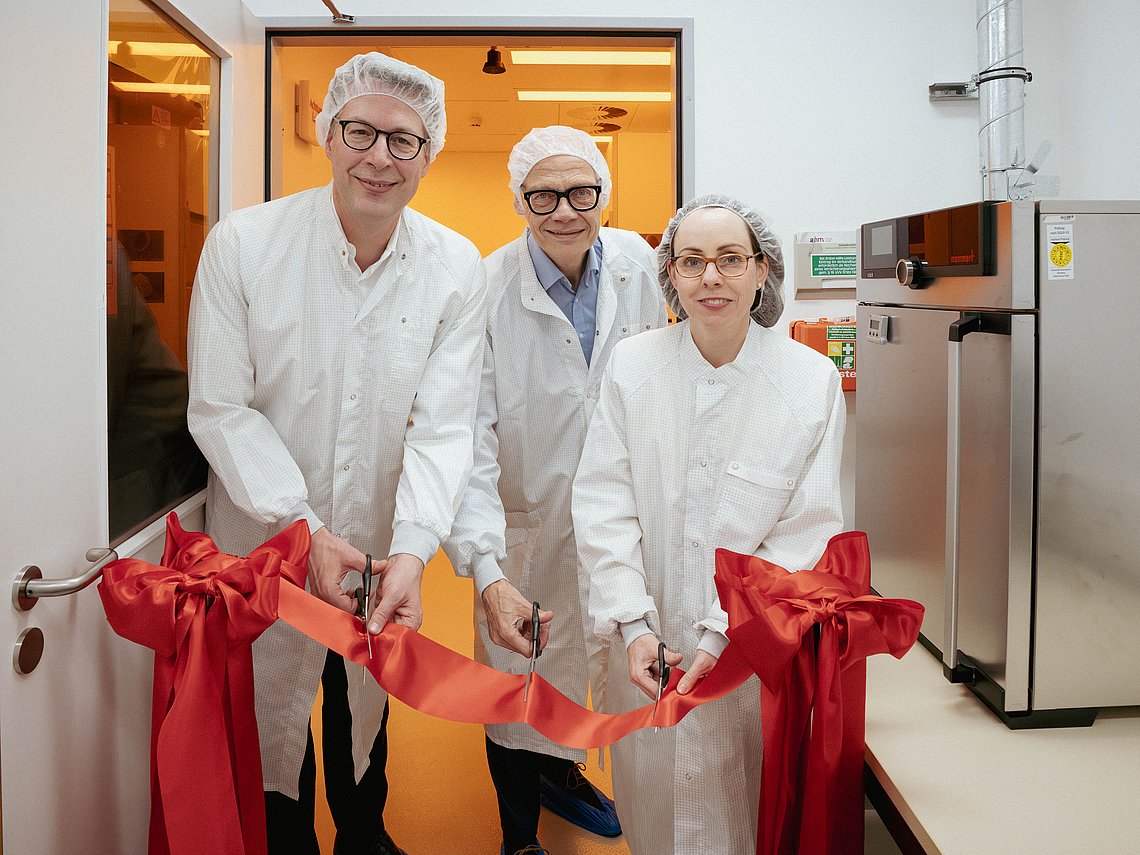
Modernised cleanroom for quantum research at Ohm
The Technische Hochschule Nürnberg Georg Simon Ohm (Ohm) has opened its comprehensively modernised cleanroom in collaboration with Minister for Science Markus Blume. Equipped with state-of-the-art large-scale equipment, the university is thereby strengthening its research activities in the forward-looking fields of optical quantum technologies and additively manufactured electronics.
The Free State of Bavaria, the EU and the German Research Foundation are funding the expansion of the infrastructure and the associated research work with several million euros, thereby creating the conditions for translating the results of quantum research into industrial applications.
Markus Blume, Bavarian Minister of State for Science and the Arts, emphasised: “Here, a cleanroom is being transformed into a space of possibilities for the technologies of tomorrow. At the Ohm, the conditions are being created to take quantum research straight from the laboratory into practical application – and to turn scientific excellence into tangible value creation. Where research is being conducted today with the utmost precision, the foundations are being laid for the applications of the day after tomorrow. The fact is: the transfer from research to practice determines our technological competitiveness. Bavaria is investing specifically in such key infrastructures and is consistently expanding its quantum ecosystem – from research right through to industry. In this way, we are strengthening our technological sovereignty and bringing innovation into practice more quickly.”
Quantum technologies are regarded as key technologies for high-performance computers, secure communications in critical infrastructure, and highly sensitive sensor systems, for example in medical technology or semiconductor production. They require high-precision optical components such as lasers, fibre-optic systems, specialised filters and micro-optics in order to generate, manipulate and detect quantum states in a targeted manner.
Ohm President Prof. Dr Niels Oberbeck said: “By modernising our cleanroom, we are creating a central infrastructure at Ohm to further develop quantum technologies from the scientific concept through to industrial application. Targeted investments from the Free State of Bavaria, the EU and the German Research Foundation enable us, together with partners from science and industry, to make a lasting contribution to Bavaria’s technological sovereignty and innovative strength.”
In the modernised cleanroom at the Ohm, state-of-the-art large-scale equipment is used to conduct research into micro-optical systems, fibre-optic components and colour centres in diamonds. In addition, additively manufactured electronics form another key area of research: here, novel digital printing processes are used to produce electronic components and functional structures directly and in a material-efficient manner. These so-called enabling technologies are a key prerequisite for translating the results of basic research into industrially viable applications – for example, for future quantum computers. The cleanroom thus provides the infrastructural conditions to systematically advance the transfer of research results in cooperation with academic and industrial partners.
The research work is funded with two million euros by the Bavarian State Ministry of Science and the Arts as part of the “Programme to Strengthen Interdisciplinary Teaching and Research Capacities in the Field of Quantum Sciences and Quantum Technologies”. The fundamental renovation of the cleanroom, which is over 30 years old, was realised with a further 500,000 euros from the Free State of Bavaria as well as the university’s own funds.
In addition, the researchers successfully secured external funding for key large-scale equipment: a two-photon nanolithography system and a femtosecond laser workstation were procured at a total cost of 1.3 million euros, with half the funding provided by the Free State of Bavaria and the other half by the German Research Foundation (DFG), and were commissioned last month. In addition, there is an existing multi-material 3D printer worth 410,000 euros, which is also integrated into the modernised cleanroom. A further €750,000 in EU funding is being channelled via the European Regional Development Fund (ERDF) into knowledge transfer, particularly to small and medium-sized enterprises. This equipment is creating a technology platform at Ohm University of Applied Sciences of great strategic importance for future research and transfer projects.
The cleanroom is used by the faculties of Electrical Engineering, Precision Engineering, Information Technology (efi) and Applied Mathematics, Physics and General Sciences (AMP), as well as at the Polymer Optical Fibre Application Centre (POF-AC) and the Institute for Chemistry, Materials and Product Development (OHM CMP) for research projects, ongoing doctoral research and teaching on Bachelor’s and Master’s degree programmes.
As an associate member of Munich Quantum Valley, the university is making a substantial contribution to the further development and application of quantum technologies in Bavaria and beyond. At the same time, the existing research focus on ‘Materials and Production Engineering’ is being strengthened and expanded to include a highly topical field of science that is experiencing strong international growth.

© Axel König / StMWK | Markus Blume, Bavarian Minister of State for Science and the Arts, will officially open the modernised cleanroom at the Ohm alongside Ohm President Prof. Dr Niels Oberbeck and Dr Andrea Heilmaier, Nuremberg City Council’s Economic and Scientific Affairs Officer.
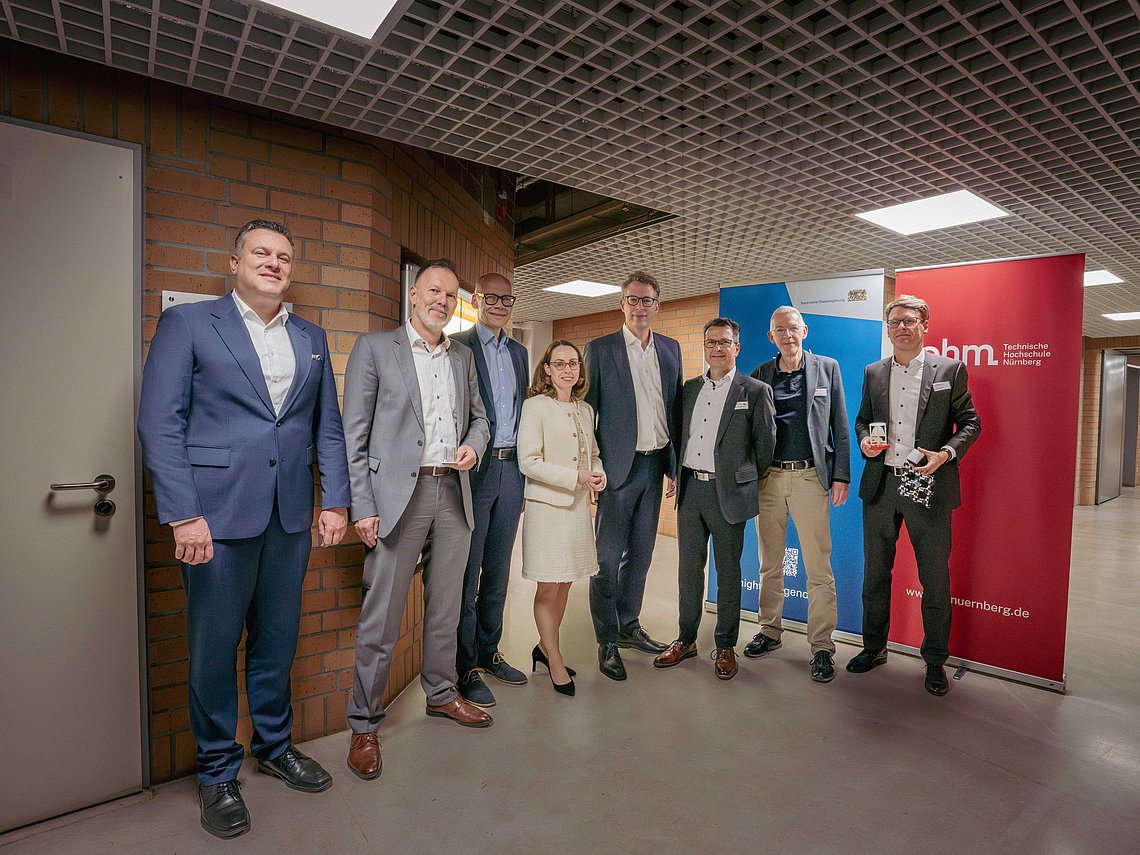
© Axel König / StMWK | Dr Tobias Haaf, Senior Ministerial Officer for Bavaria; Prof. Dr Marcus Reichenberger; Prof. Dr Niels Oberbeck, President of Ohm University; Dr Andrea Heilmaier, Councillor for Economic Affairs and Science for the City of Nuremberg; Markus Blume, Bavarian Minister for Science; Prof. Dr Rainer Engelbrecht; Prof. Dr Bernd Braun, Prof. Dr Andreas Stute (from left) in front of the modernised cleanroom at the Ohm.