

Fraunhofer IIS is testing robotic assistants at the airport
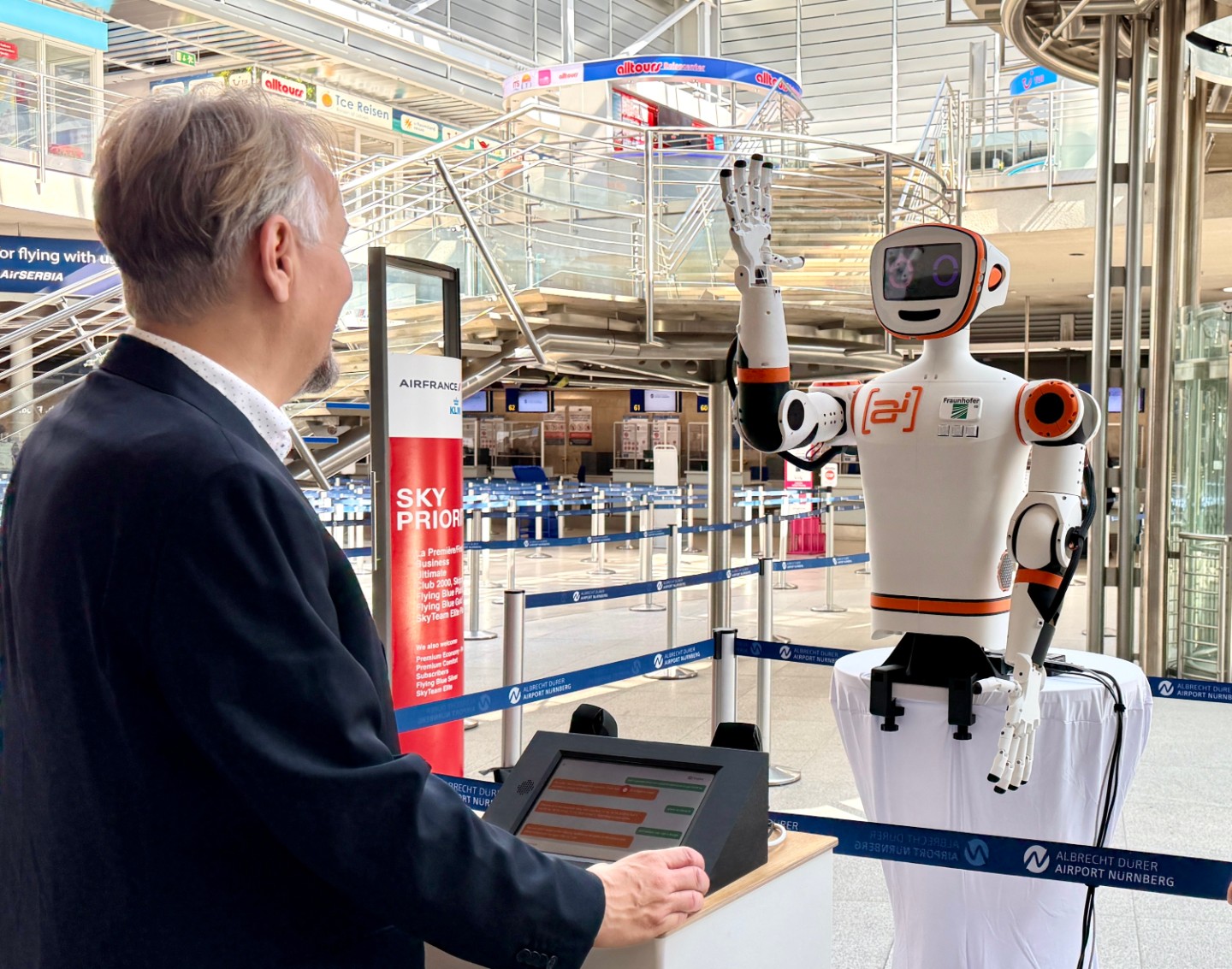
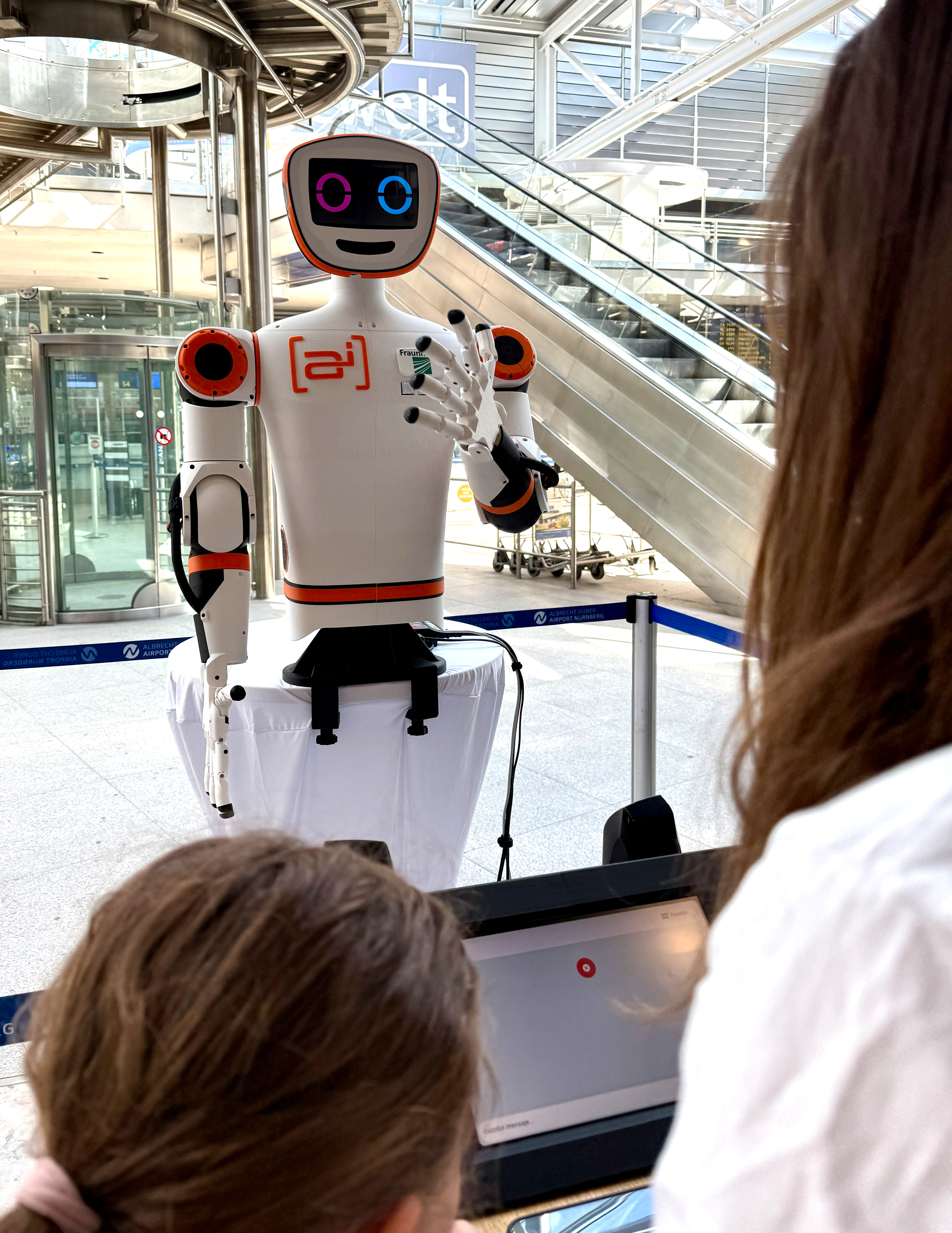
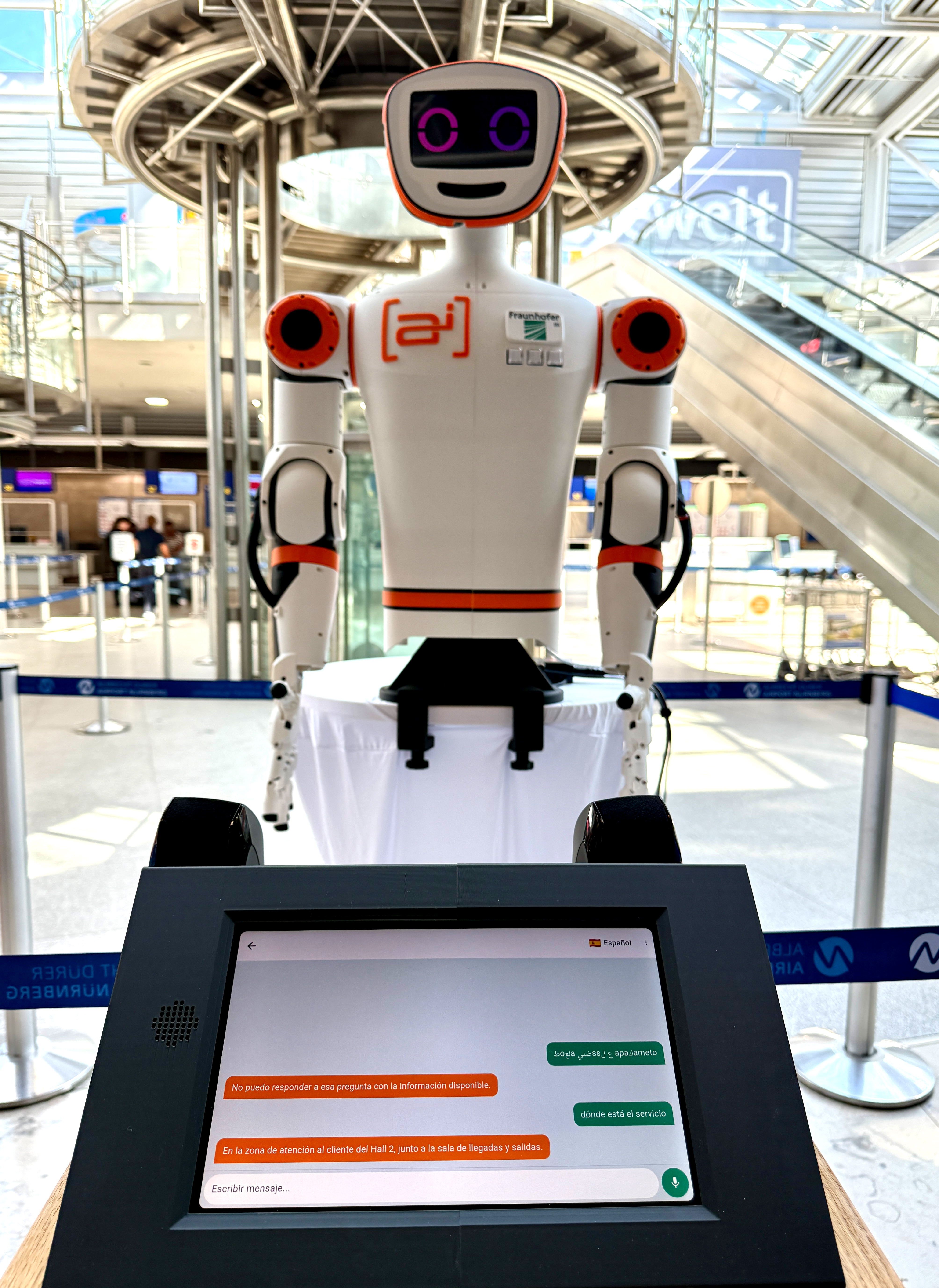
In May, the Fraunhofer Institute for Integrated Circuits IIS, in collaboration with Albrecht Dürer Airport Nuremberg, tested a mobile, AI-based robot designed to provide information to travellers. The prototype answered typical questions, such as those relating to parking or the restaurants and counters at the airport. The aim was to evaluate the acceptance and performance of humanoid assistance systems in public spaces. The assistant responded to spoken questions in various languages. To achieve this, the researchers optimised various AI models to enable processing as an edge AI solution directly on the device, without requiring cloud access. This ensures that privacy and data sovereignty are safeguarded.
On 26 May, the future of travel assistance was put to the test at Nuremberg Airport: without having to take out their smartphones, travellers and those waiting were able to obtain information about the airport from an information robot in the departures hall.
Local, autonomous ‘robot language brain’ conducts information dialogue
Many people are familiar with digital systems based on voice input from cars or dialogue-driven call centres, as well as AI chatbots on websites. These are powered by large AI models that run in data centres via a cloud connection. For the approach presented at Nuremberg Airport, three AI models were specifically scaled down to enable local and rapid operation. One model is for multilingual understanding of spoken language, one for understanding and answering questions, and one for generating spoken language in the enquirer’s own language.
Normally, enquiries are transmitted to large and computationally intensive AI models in the cloud and processed in data centres. In the approach presented here, the enquiries are transcribed from audio recordings into text; the enquiry is answered via a compressed local Large Language Model (LLM) connected to the Retrieval-Augmented Generation (RAG) system – also developed at Fraunhofer IIS – and the response is finally output via loudspeakers using a text-to-speech model.
What makes it special is that all models run locally on an edge device, and no sensitive audio data leaves the device.
For the project in Nuremberg, researchers at Fraunhofer IIS integrated extensive airport-specific information into these models in order to provide travellers with accurate and context-specific information.
“The AI experts at Fraunhofer IIS in Nuremberg have developed a robot for this purpose, which acts as an autonomous information assistant. As a company with deep roots in the region, we are delighted to be a partner in this project. We are offering Fraunhofer IIS a platform to gain practical experience, and providing our guests with an exceptional, innovative information experience,” says Christian Albrecht, Head of Corporate Communications at Nuremberg Airport.
AI works even without the cloud
This modern, AI-powered source of information is particularly useful in situations where you need quick, up-to-date information that you don’t want to have to type into a command line first. But what happens if the Wi-Fi goes down or the internet connection is lost? Here, too, the approach developed by Fraunhofer IIS is the key.
“Thanks to our expertise in edge AI, we’ve been able to design a highly efficient LLM and the models for language understanding and generation so compactly that they run directly on the embedded platform, independently of any internet or cloud connection,” explains Dr Axel Plinge, Group Leader for Efficient AI at Fraunhofer IIS, describing the development work. “This means that questions are processed and answered directly on this platform; they do not need to be transmitted or stored. This is a major advantage for data security and sovereignty. It is a real stroke of luck for our region that, through this local partnership, we are not only able to develop future technologies but also make them immediately accessible.”
Practical research with direct added value
The aim is both to test the appropriate hardware and system architecture under real-world conditions in an airport environment and to determine whether this form of interaction can gain acceptance amongst travellers. Consequently, not only technical functionality but also aspects of user-friendliness are being tested in order to gain further insights for the development of a practical, end-to-end system. Through this robotic assistance project, Fraunhofer IIS, in collaboration with Nuremberg Airport, is demonstrating how modern AI technology can be integrated into everyday life in a practical way: powerful, data-secure and independent of external infrastructure.
© Fraunhofer IIS/Christina Müller
© Fraunhofer IIS/Christina Müller
© Fraunhofer IIS/Christina Müller